Nephillim The Giants of Lore

        The Nephilim

     The word “Nefilim” is a biblical term, a Hebrew word that is not found in any Sumerian text. Many bible translations , translate Nefilim as the English word for “Giant”. The word “giant” for good reason as Deuteronomy 3:11 points to an ancient King’s bed, of the Nefilim,  “Behold his bed of iron….Nine cubits was it’s length, and 4 cubits’s it’s breadth.”

    Some would suggest that the Hebrew word for Nefilim means “the fallen, or cast down”, which is taken from the Sumerian root,”NFL”, but again this word was never used in this context by the Sumerians. The Hebrew form nephilim cannot mean “fallen ones” (the spelling would then be nephulim). Likewise nephilim does not mean “those who fall” or “those who fall away” (that would be nophelim). 

     So who were the Nefilim? The book of Genesis states,” the son of the gods saw the daughters of men, that they were good, and they took them for wives.”  “the Nefilim were upon the earth….sons of the gods cohabited with the daughters of Adam and they bore children unto them.” So the sons of the gods produced children upon the the earth called the Nefilim. These children were hybrids, what the Greeks called demigods, and as the English translation suggests they were giants among man.  They often dominated man and were often in conflict with man. Many records suggest they also lived a very long time in comparison to mankind. They also had noticeable features, that set them apart from the rest of mankind. Often they were unable to reproduce. Similar to crossing a horse with a donkey. Mules are sterile, because they are hybrids, and many of the Nefilim, because of being hybrids, were also sterile.

     The bible text also refers to many of them as having unusual deformities, such as having two rows of teeth,  and an extra digit on each hand, along with six toes on each foot, as recorded in 2 Sam 21:20; “he also was born to a giant”. The Israelites were in conflict and often at war with these Nefilim. Still the dominate and most recognizable trait of the Nefilim was that they lived a very long time in comparison to man.

Incised style rock art representing a human hand. Hanakiyyah, Saudi Arabia

The ancient drawing is from Saudi Arabia, showing giants (Nefilim) having 6 digits.

     A Scandinavian writer/explorer and Zoologist wrote a very popular book named Kon Tiki, which told of ancient tales in Peru that spoke of a Great God that lived with his people near Lake Titicaca. These people were unlike the native Peruvians because of their light skin, and their god like appearance. Their leader’s name was Kon Tiki, and they soon came into conflict with the local people of the area, which lead to their numbers being decimated. Kon Tiki led them to the shores of Peru where they escaped westward across the Pacific. The story is next picked up in the Polynesian islands in the Pacific, where a great God comes ashore from the east, bearing the name Tiki. The ancient stories seem connected, as the book Kon Tiki suggests, strongly suggesting that these are the same gods. Many experts in the field have long displaced this theory, stating the islands in the Pacific were settled by Asians, not Americans.

     It is interesting to note that Tiki is an ancient Sumerian word, which means “those that live on earth / those that  have life on earth”. Was Kon Tiki and his people ancient Nefilim? Were the Nefilim not just precluded to living in the area of the Valley of Sumer?

     Aerial photos taken just south of Lake Titicaca.

      These man made formations were just recently discovered. Was the lake region, thousands of years ago, highly developed, with populations supporting land management, and possible irrigation, similar to the region of the Valley of Sumer.

     Native tribes in North America have ancient tales describing fighting with “fair skinned giants having red hair”. In fact caves have revealed in the America arid lands of the south, the skeleton remains of red haired giants.

     One of the most famous of these Nefilim was Sargon the Great.  Dagan, the Akkadian Great God, whom was the 1st god of the Semitic people, was able to take a priestess to bear his seed, Sargon, and with his direction and the power of his weapon, as seen in the Stele of Naram-Sin, would take this Semitic King of the Akkadians to be a dominant world power.

                                {Dagan the First God of the Semitic People Blog}

     Dagan saw this same opportunity exist in Egypt. One man under his control, in a position of power, to lead his people. His Semitic people resided in the rich farmland of the Goshen, so all that was missing was a Sargon like figure, to enter the Kings court and take the ruler ship of Egypt, just as Sargon did many years before in Akkadia. Sargon came from nothing, from the reeds of the Euphrates, to become the most powerful King of the Ancient world. Dagan needed the same event to occur in Egypt.

     Now history takes a darker turn. as Dagan, the Great God of Sumeria, now moves into the court of the Egyptian Palace. Dagan was extremely intelligent, and his knowledge of the world would seem invaluable to the ancient court of Egypt. He would soon rise to an adviser to the King himself, Amenhotep 3rd., just as Sargon became cup bearer to that ancient Sumerian King years before, and into a position of influence and power, now he would await his opportunity. Here in the court of the Egyptian King, Dagan would need to place his seed to rule in that court of Egypt, the existing world power. His opportunity soon came when he fell into the bed of the Queen of Egypt to produce that seed. A seed that would lead his Semitic people to the ruler ship of the world.

                                                   The Plan of the Anunnaki

      These Great Gods of the Sumerians have long been interfering in the fate of mankind. They do this by simply putting their seed, a Nefilim, into a position of power to ultimately control man’s fate. These Nefilim are often of uncertain heritage, have extreme self-confidence, are natural leaders,exhibit ruthless behaviour, are often wealthy and powerful, and may hold a position of high political value. The Anunnaki use their Nefilim to position their seed into ultimately being world powers and most importantly destroying the seed of other Anunnaki. This is accomplished usually by wars, or it can take the form of a political  advantage, or a financial advantage.

     The same method to gain control of a world power has been used by the Great Gods over and over again.

         Ruler                  Ruler’s mother               Ruler’s father (real)      Circumstance of ruler 

        Nabonidus          priestess                      unknown  (Sin)           complicated and violent

        Sargon                 priestess                      unknown  (Dagan)        complicated and violent

        Moses (Tothmoses)   Queen                        unknown  (Dagan)         panicked and ran

        Hitler                   common                     unknown  (Nazi)           complicated and violent

    After the Crown Prince of Egypt was born, Dagan would watch over him, and continue to gain his friendship, all the time waiting for just the right time to tell him who he really was, and what his real destiny was.

    Crown Prince Tuthmoses, spelled Thothmes in older texts, the son of Amenhotep the 3rd., was now a young man, nearing his poistion as Regent, but soon after disappears from Egyptian record. The recumbent bier now located in the Berlin museum, seen below, clearly defines his name in hieroglyphs as “Thothmosis the true voice”, not Tuthmosis as modern scholars would have us believe. The Egyptian God Thoth was a very prominent god to the  Ancient Egyptians. There is no Egyptian god named Tuth, so early writings were correct in this pronunciation. This is a deliberate attempt to miss pronounce his name.

What became of the Royal Regent? The Regent was now a politically powerful young man. Perfect timing for Dagan to make his move. He told the Crown Prince  who he really was, not the son of a King, but the son of a God.

Thothmoses was servicing a real need in fulfilling Dagan’s purpose. To Dagan’s surprise Thothmoses was not like Sargon, who immediately had taken that opportunity to become King and ruler of the world. Thothmoses was in shock, unbelievable shock, and horror. He could not accept what he was hearing. He ran through the palace looking to confront his mother, to find out the truth. All the while the rumor was spreading through the palace like wild fire, until it reached the King. It wasn’t long before the Queen broke down and told the truth. Thothmoses life at this point was over. Instead of doing what Dagan expected him to do and follow the path of Sargon, he did the opposite and ran.

     Dagan’s life was now in danger, for without Thothmoses taking the crown from the King, his plan of world power was now useless. He had no other course than to run from the palace and from Egypt, but with him, he took Thothmoses. Thothmoses once crown prince was now Moses, a simple shepherd with no home.

     Moses was an Egyptian name, not a Hebrew name, as most Jews and Christians would suggest. The Egyptian name Ramsses, given to a number of Pharaohs, was also derived from this same root name. Ra being the “Sun God”, and msses meaning “born of”, is the same root as moses. In Exodus 2:19 it says Moses was an Egyptian, not a Hebrew. In the presence of close family members the Crown Prince, may certainly have been called Moses as a pet name.

     Moses for many years refused to return to Egypt, but after the death of the King of Egypt, Dagan became ever more insistent. This all came to a dramatic climax as Exodus 4: 21-26 states; “And it came to pass by the way in the inn that the Lord met him (Moses) and sought to kill him.” Dagan demanded that Moses return to Egypt so that Dagan could fulfill his plan of world domination for the Semitic people living there. Moses was then forced to return to Egypt and begin a life’s tale that would encompass the world’s belief.

     From this point onward Moses became the most famous Nefilim, but later this would also work against him. Prior to the Israelites entering the land of Canaan  Moses climbed the mountain to look over the land of Canaan, a land he would not enter. He would have been close to 150 years old at this point. His age and possible his larger statue would have made him look suspicious to the Hebrews, for they were well aware of the Nefilim, their size and there reputation for long life. In Numbers 13: 30-33 the Hebrew spies sent into the Land of Canaan reported. “And there we saw the Nefilim and we seemed to ourselves like grasshoppers”.

      He at this point would have been over twice the age of the oldest Hebrew. This fact would have left Moses, very noticeable, and of no further use to Dagan. Dagan took him to the top of the mountain not to die, no tomb, or grave site has ever been found of Moses, but to disappear.

    Moses lost his usefulness and needed to disappear. After climbing down from the mountain he soon went north and then west.

     Moses name was Thothmoses which means “born of Thoth” or “child of Thoth”. In English that word simply means Toth’schild. Moses now needed to hide his true identity, so he needed a new name. Moses worshipped Ra the sun god of Egypt, so he changed his name to Rothschild by simply switching the Th for the R.

    The name Rothschild came out of No where in Frankfurt, Germany in the late 1500’s. The most famous and one of the earliest Rothschild was Moses Kalman Rothschild and his son Amschel Moses Rothschild. Amschel created the famous international Rothschild banking network. What makes this a link to Moses was not just their names, which was a pet name given to him by his mother and sisters in the ancient court of Egypt, but the fact that inscribed on his gravestone, just above his name is the Flying Sun Disc of ancient Egypt. The ancient symbol very familiar to Moses of Egypt, and like his name, held a special meaning to linking him to his past.

The grave stone of the Amschel Moses Rothschild, founder of the Banking Empire.

     This links the Crown Prince of Egypt Tothmoses, to the Rothschilds of Germany.

     The other unusual link is that the Jews in Germany who lived in total peace with the surrounding German for hundreds of years, were living in what can be referred to as “tin pan alleys”. The Jews were a people that were living in impoverished conditions, until Moses Rothschild. Moses and his son Amshel within 2 short decades brought the Jewish people from selling rags in push carts throughout Europe to become the most prominent and wealthy group in Europe.  They built castles for homes that still exist today. Their wealth financed what would become referred to as the “Golden Age of Banking”. This was the age of Bismark of Germany. Vast fortunes were made by the Jewish Banking sector, and by the late 1800’s this wealth was now being transferred to New York in America. This was one of the world’s largest transfers of wealth. It would pale the wealth transfer decades later, in the 21st Century, from America’s middle class into these NY investment banks. Hundred of Billion of dollars were moved into NY. The investment Banks of Goldman Sachs, Bank of NY, and Lehman Brothers were all German Jewish Banks that set up Banks in America. This allowed the recapitalisation of America, and fore shadowed NY to be the centre of world banking. All investment banks in NY that were soon built, were with rare exception initially set-up by German Jews. Lehman Brother were actually Austrian Jews.

File:Rothschild Schloss.jpgFile:4859 VER5137 Revelation studios.jpg

    The ancient adage, “from rages to riches” comes from the Rothschild quick rise to wealth, and their prominence. They built their castles throughout Europe.

     World domination, if not by power, than by finance. Control the world’s banks and you control the world.

Azazel and the Book of Enoch

 Book Of Enoch

The Book of Enoch was an ancient manuscript found in caves in Ethiopia, mostly written in a language called Geez, but some text is also in Aramaic, Greek and Latin

The text relates an ancient pre-flood story, that entails 200 Watchers, or angels that make a pact amoungst themselves. This pact involves taking for themselves the most desirable women of the earth, and mating with them. It also involves using the secrets of heaven and teaching mankind these secrets, that were never to be known to man.

These Watchers, had leaders, leaders of 10 and counsel leaders. The most important of the watchers had names that were recorded by Enoch. Semjaza was their leader, and he gathered the Watchers together on Mount Hermon, an ancient place of gathering, where they formulated their plan and swore to it.

The 200 Watchers descended upon mankind, and cohabited with the women of the earth, whom bore them giants. Nefilim in the Bible. Giants of tremendous size. These giants ate all the produce of man, then turned on mankind itself and devoured man and animal alike. The Watches not only bred with the women of mankind, but also bred with animals, that produced what Enoch calls monsters. The greatest of these monsters was named Leviathan. Mankind and animals alike are not able to inter bred between species, because our DNA is so dissimilar, but apparently the Watchers DNA was able to bred with numerous species, some completely different genetically.


Image result for ancient gods 1/2 man and beast


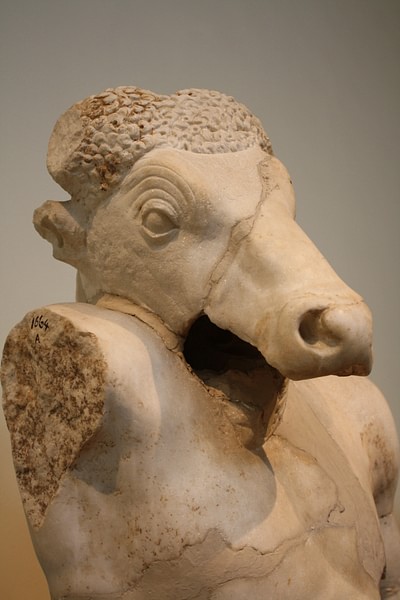
In Sumerian art there is often depictions of a 1/2 man monsters and also the famous Minotaur of Greece is similar in content. Could these be the results of monsters named in the Book of Enoch.

The names of the leaders of the 200 Watchers, (notice the similarity to the 300 Annunaki in the Sumerian text that came down to earth to administer the fate of man), are listed in the Book of Enoch. Danel, Turel, Rameel are a few, and most of their names end in “el” , which means god.  El was the ancient god of the land of Canaan. The most famous and a counsel to the 200 was Azazel. His name would mean God of hardening or God of strengthening. Azazel brought to earth the secret art of strengthening or the hardening of metal, to make implements of war. This allowed mankind to make war on each other, and bring destruction upon the earth.

In  Chapter 8 of the Book of Enoch it states;

And Azazel taught men to make swords, and knives, and shields, and breastplates, and made known to them the metals of the earth and the art of working them, 

Soon the heavens saw what the 200 Watchers had done to earthly man, and the destruction that was brought upon mankind, and they told this to God (Anu in Sumerian).

Thou seest what Azazel hath done, who hath taught all unrighteousness on earth and revealed the eternal secrets which were (preserved) in heaven, which men were striving to learn: And Semjaza, to whom Thou hast given authority to bear rule over his associates. And they have gone to the daughters of men upon the earth, and have slept with the women, and have defiled themselves, and revealed to them all kinds of sins. And the women have borne giants,

Then the Lord God decreed, and spoke a command to Rafael his angle.
And again the Lord said to Raphael: ‘Bind Azazel hand and foot, and cast him into the darkness: and make an opening in the desert, which is in Dudael, and cast him therein. And place upon him rough and jagged rocks, and cover him with darkness, and let him abide there for ever, and cover his face that he may not see light. 


     There is a great battle that takes place at a site that was called Aryan-Waizan and many of the giants are killed, along with the death of angles including apparently Rafael. There is two great giants on earth that are brothers, and they seem to dominate the affairs of the other giants and man. There names are Ohya and Hahya/Ahya. These two giants have no equal and are seen as rulers of earth, and their rule would last forever.
Ohya and Leviathan and Rafael are involved in a long protracted battle, in which all three disappear. This is a tale that apparently is retold many times to children using animals in place of giants and a monster. as recorded below.

like unto the fight in which Ohya, Leviathan, and Raphael lacerated each other, and they vanished; like unto the story in which a lion cub, a calf in a wood, and a fox lacerated each other, and they vanished.calf in a wood, and a fox lacerated each other, and they vanished.


     In Chapter 10 of the Book of Enoch it states that Semjaza will be bound and has to watch the slaughter of his children. The 200 are then imprisoned until judgement. This is clearly very similar to The Book of Jeremiah when the King of Babylon Nebuchadnezzar, binds the King of Judea, and forces him to watch as his children are all put to death, then he is blinded, and put into ever lasting darkness, when he is taken to Babylon where he is imprisoned for the rest of his life.

This is at the ancient location of Riblah of Hamath. Riblah was an ancient crossroad, of three major routes. The road south went into the land of Judea, the route north into modern day Syria, and the route east went to Babylon and the valley of Sumer. Just as modern armies seizes important military crossroads, ancient armies did the same. The King of Babylon and a small army held this northern crossroad while his main invading army crushed Judea. This same military tactic was used earlier by the Egyptians when they conquered Judea.

Did Rafael hold this crossroad, not allowing the giants to escape from the region of Lebanon, only too find himself in battle with the great giant Ohya and the monster Leviathan? Today Riblah is nothing more than a old grave site, but does this have significance to the battle of giants and gods.Were many of the giants rounded up and slaughtered before the Watchers at this site?

The ancient gods were very vindictive and vengeful, and would take this opportunity to repeat what they felt as a personal wrong against their seed. They would have used Nebuchadnezzar to repeat this act at the same location to reinforce what was done to them and their seed, centuries earlier. It’s also possible that some of the giants were buried there at Riblah, as evidence that even today it’s a large ancient grave site.

The ancient Greeks also told of this great battle between the Gods and Giants. This Greek bronze shows a giant throwing large rocks in their effort to overthrow the gods. The Viking’s beliefs also included giants fighting the gods in their attempt to destroy Asgard, the home of the gods, but the gods fought back using a great hammer.


.Image result for bronze of a greek giant throwing rocks

    This ancient battle between gods and giants has been told down through the centuries, by many different peoples.

The question that many ask is what happened to Azazel? The children of these gods that were left after the battle, the Nefilim, now would gather their dead and bury them. Then soon after, build a memorial for the en-captured Azazel. This was built at Baalbek. The size and immensity no man has seen or duplicated. Below is a stone that was never completed still lays near the site. German archaeologists recently found in February of 2015,  after extensive digging, the largest stone ever unearthed, which weighed in excess of 1650  long tons. This stone was found at Baalbek.

The ancient tales surrounding Baalbek is that it was built by giants prior to the flood, which coincides with the Book of Enoch. It’s also possible that this site that stands as a memorial, is the site where Azazel is held in captivity in Dudael. In the text above, rocks are placed over his entombment. Could these be the giant stones at Baalbek that seal his exit?  Buried deep below this site, and bound is Azazel.

Babylonian Ancient History of Mankind

Oannes and the Annedoti

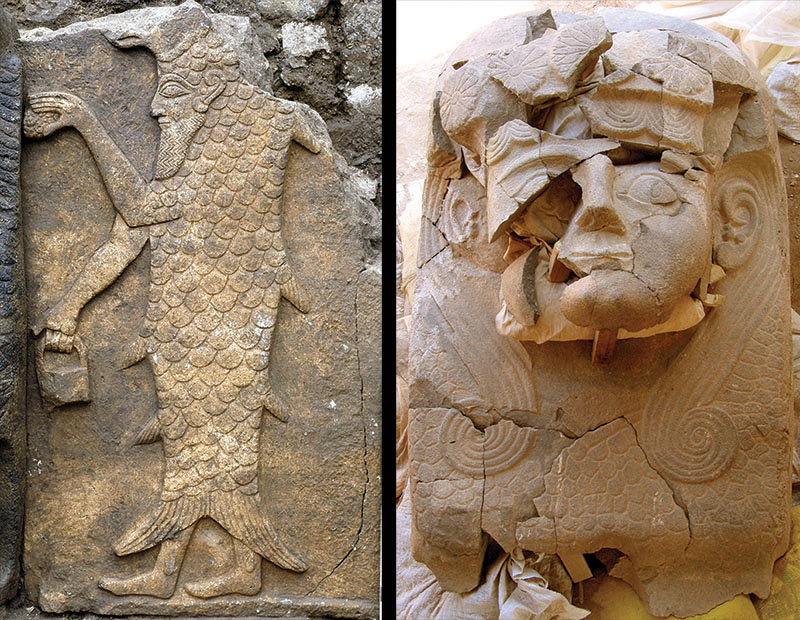
The ancient history of the Sumerians, Assyrians and Babylonians all are dominated by reliefs of figures that feature a 1/2 human 1/2 fish resemblance.

Picture


The figurines above came from Nineveh, that show the creature 1/2 fish 1/2 man Oannes.

The original text has been lost, but was later recorded with diligence by an ancient Greek named Berossus, that was first translated in 1876. The text records the traditional history of mankind known by the Babylonians. Their development was possible because of the knowledge that was given to  mankind by an Amphibious creature, 1/2 man and 1/2 fish, named Oannes. Oannes was from the Musari or the Annedoti creatures. Oannes first appeared to mankind during the reign of Ammenon of Babylon. The word, “Annedoti” means repulsive, while the word “Mursarus” means abomination. Evidently Oannes and the Annedoti were extremely offensive to mankind. They were literally ugly monsters, that repulsed man, but were totally benign. What Oannes did was to depart to man knowledge.

The text below is part of that translation;

In the first year there made its appearance, from a part of the Erythraean sea which bordered upon Babylonia, an animal endowed with reason, who was called Oannes. (According to the account of Apollodorus) the whole body of the animal was like that of a fish; and had under a fish’s head another head, and also feet below, similar to those of a man, subjoined to the fish’s tail. His voice too, and language, was articulate and human; and a representation of him is preserved even to this day.

This Being in the day-time used to converse with men; but took no food at that season; and he gave them an insight into letters and sciences, and every kind of art. He taught them to construct houses, to found temples, to compile laws, and explained to them the principles of geometrical knowledge. He made them distinguish the seeds of the earth, and showed them how to collect fruits; in short, he instructed them in every thing which could tend to soften manners and humanize mankind. From that time, so universal were his instructions, nothing has been added material by way of improvement. When the sun set, it was the custom of this Being to plunge again into the sea, and abide all night in the deep; for he was amphibious.

After this there appeared other animals like Oannes, of which Berossus promises to give an account when he comes to the history of the kings.
NOTE; The Erythraean Sea is now called the Arabian Sea.
Can the history of man be believed from the stories, myths traditions of ancient people. Is it possible that at the very beginning there existed 2 distinct species of mankind? They were able to coexist.

Enki’s, the Sumerian God, in the relief above, pictures him atop his Ziggurat, with his signature water pouring form his image. This water depicts his power over the Abzu. The Ziggurats were thought to have large basins of water, at their top. Were the Abzu, and their water ceremony, more than just a religious act, but a significant part of the these Great Gods life? Were the Abzu necessary for the Great Gods existence? Just as Oannes had to return each night to live in the Ocean, did the Anunnaki have to return to the Abzu, which contained a transformed water, since they were a considerable distance from the Ocean.

Here is shown a Great God ascending out of the Abzu which is located atop the Ziggurat.

In Canaan, Dagan is seen as a half fish, and there are reliefs throughout the ancient world that show a half man, half fish God, that is thought to be Dagan.. Could it be that the Anunnaki take a form other than man in the underworld? Is Dagan one such creature?

In Exodus 33:20, Yahweh is speaking to Moses; “No man can see me and live”. Is the reason that Dagan/Yahweh is unwilling to show himself, is that he is an abomination to mankind? That his appearance doesn’t project an image of worship, but projects horror. The ancient figure below illustrates Dagan.

         In the Sumerian language, priest or priestess, has been translated, into the word “changeling”. The Sumerians, in their reliefs of the Anunnaki were again merely drawing what they observed, or were they myths? Were the Annunaki able to transform into a human form? The fishman figure below were common in the ancient world.


          What makes the stories believable is that these fish like humans were drawn in reliefs throughout ancient history, and that they were considered an abomination by man. If you were writing a myth, why would you make these creatures repulsive to man, and yet beneficial?

Dagan The God of the Semitic People

     Dagan the First God of the Semitic People          

Dagan rose from being an almost unknown god amongst the Great Gods of Sumeria, to becoming the predominant god of the Semitic Akkadians. Dagan rose to power by victory. Dagan assisted Sargon and especially Sargon’s Grandchild Naram-Sin, to defeat their enemies, and enable their Akkadian empire into a position of world power. In the great Stele of Naram-Sin, Naram-Sin is seen looking up to what the underlying text calls the great weapon of Dagan.


The text reads; “Naram-Sin slew the Arman and Ibla with the weapon of the God Dagan, who aggrandize his region”. Take note of Naram-Sin in the stele above as he gazes upward at this great weapon. The weapon is a four wheel chariot with the two wheels on one side extending outside of the relief. If you look even closer you will observe that at the end of each axle are two wheels, one inside the other.

This is exactly what the prophet Ezekiel saw in the famous appearance of Ezekiel’s chariot. Ezekiel 1: 16 states; “The appearance of wheels…. and the four had one likeness and their work was as it were a wheel within a wheel”. Dagan, the Sumerian word, and later Yahweh, the Akkadian/Hebrew word were the same god.


The photo above taken from the NASA images, web page below, shows what appears as a space vehicle with a wheel within a wheel. Image is 1/3 up on the right edge. I apologize for the fact that NASA has taken down the original web site, and I can no longer show this web page. The image above appears to be well over 200 km across.

The prophet Daniel saw these chariots as, “the chariots of the gods”. The prophet Elisha was surrounded by “chariots of fire.” They were depicted throughout the regions of Sumeria, Akkadia, Babylon, Persia and Assyria , for several thousand years.

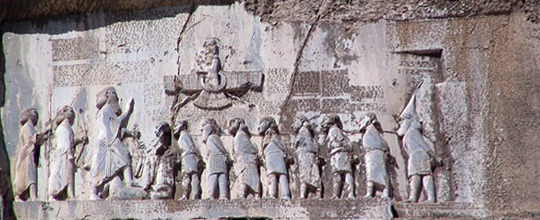
Again, above we see the same Anunnaki throne/chariot leading an army to victory. This relief is in Persia, at the famous site of Behistun, depicting Darius the Great’s victories, after the death of Cyrus. It appears the Anunnaki took an active part in the wars of man.

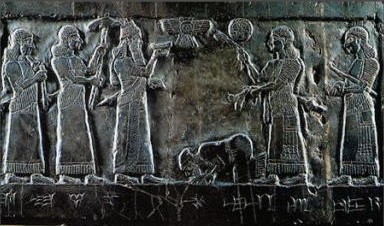
Another great example of this interference by the Anunnaki in the wars of man is when the Assyrians defeated the 10 tribes of Israel and commemorated that event by raising the famous Black Stele, seen below. In the middle bottom of the stele is Jehu, the King of Israel, who is seen in bonds, and above this figure is the Great weapon of the Anu, the chariot of the Gods of Anu, which assisted in Jehu’s defeat.


In the figure above the Anunnaki are seen here on either side of the tree of life, with their Chariot of the Gods above them. Many historians have determined that this throne chariot, seen above the tree of life, is really an ancient Sun God, but when has a Sun God  taken two hitchhikers, on a ride. This depiction done by the Sumerians of a chariot of the Gods was drawn from what they observed, not some mythological Sun God. The  Anunnaki on either side of a tree of life, with the throne /chariot above them , is repeated over and over in their reliefs.

An art form of an ancient “Chariot of the Gods” depicted below, was drawn or engraved on nearly every early stele from the time of Sumeria to the Persians covering a period of several thousand years. In most cases the images carried one or more personnel, had wings to indicate flight, and also indicated a wheel within a wheel of eight spokes. Take special notice, the eight spoked wheels on the stele of Naram-Sin and the chariot below are drawn exactly the same. Drawn just behind the figure with the bow.


The Sumerian relief below shows a Great God riding a four wheeled chariot, with the ability of flight, as shown by the flying sphinx. Just above the chariot is an illustration that demonstrates that the chariots has the ability to launch or throw lightning bolts. Also the lion seems to be throwing destructive flames out of it’s mouth. These chariots of the Gods were often an integral part of the wars of man.


Dagan changes his name to Yahweh

In ancient times it was customary to have the names of major cities, and the names of Kings reflect the Gods they worshipped. The word for this is theophoric names. In the royal house of Larsa, their king was named Nur-Dagan, or in the royal house of Isin, 2 kings were named after Dagan, Iddin-Dagan, and Isme-Dagan, the later even went further, to call himself the son of Dagan.

In the Bible the son of King David is named Baalya or Bealiah which means Baal is Ya or Yehovah is Baal. Baal being named the son of Dagan and who were both worshipped by the people throughout the land of Canaan. Ya is an abbreviation of Yehovah. This to many bible scholars is a paradox, in linking Dagan and Ya, but it points to the fact that both are the same person.

The name Israel contains the letters of the supreme god of the Egyptians “RA”, and the Supreme God of the land of Canaan “El”, signifying that they were part of the Hebrews past and present worship.

In early Mesopotamia, two Kings, Yahdun-Lim and Yasmah-Addu both show the recognizable theophoric connection to Yehovah, and both were exclusive worshippers of Dagan. One calling himself the Governor of Dagan. Yahdum-Lim , the King of Mari, in present day Syria, is quoted in cuneiform text recovered from the diggings in Mari, “Yahdum-Lim King of Mari, The God Dagan proclaimed my kingship, who controls the banks of the Euphrates, and gave me a mighty weapon that fells my royal enemies.”

Again Dagan and the use of his mighty weapon, that destroys the armies of man, is mentioned. This was the very same weapon used with Naram-Sin, for his territorial expansion.  Mari, Yadhun-Lim’s capital, has extreme importance today, in that of nearly 25,000 cuneiform texts, were unearthed there.

Yasmah-Addu, was one of the 2 sons of the King of Assyria, the other being Ishme-Dagan.

Yasmah-Addu ruled in Mari, while his brother and Father ruled the other 2/3rds of the empire. Dagan as their God, is recognizable in their names, along with the use of Ya, and a son of Dagan, named Addu.

A neighboring city to Mari, in Syria is Ebla, which in the mid 60’s was unearthed  by an Italian   archaeologist by the name of Pettinato. In his diggings he discovers some 20,000 cuneiform texts.

Tablets discovered at Ebla, which is in northern Syria.

Some of which would drastically change the image of the early near east. Pettinato discovers the divine name Ya, later to emerge as YHWH or Yahweh. The Sumerian name was Dinger Ya-ra-mu, translated God Ya-ra-mu. He also makes a discovery that the letters “EL” are being changed to “YA” at this time in history. EL being the senior deity of the Canaanites to Ya the God of Moses. Pettinato notices that in the translation of the word Mikail, that those now living in Ebla have translated the spelling to Mikaya. For some reason there is a shift in spelling and pronunciation to “YA” in these cities that worship Dagan. It would seem that with the change of worship to a new God, the spelling names of cities and important locations also has to be changed. Both of these cities along with Dagan’s major temple at nearby Tuttul were major centres of worship for the God Dagan.

As the Akkadian Empire expanded and controlled the majority of the Fertile Crescent, so to did the expansion of worshiping their God.

Fig10.      The above coin from the 4th century BC, is from the location of modern day Gaza, honouring their God Yahu. Many believe, these are the people, the Egyptians referred to as the “Sea People”, descendants of early Phoenicians, whose water God was named, Yam-Nahar. Notice the cherub winged throne chariot, that is also evident in Ezekiel’s vision of Yahweh’s throne chariot.

The texts below are from the three tablets of Sin-mubalit, Hammurabi’s father, translated by Deilitzsch in 1902. This text predates Abraham.

Fig11.


The question is why would Dagan change his name to Yahweh? The answer to that is quite simple. When a God is declaring himself, as Dagan had, the “Creator of Heaven and Earth”, it is difficult for him to convince his seed of that when, Sargon and the Kingdom of Agade, had been completely wiped out. Not exactly an all powerful, all omnipotent, all knowing God. Dagan will take time to rebuild his seed and to reestablish  his earthly kingdom, but he would not use the name Dagan. If Dagan used his name, it would enable his seed to look back and examine at his past failures. Nearly 2 millennium  later his Semitic kingdom is led by another strong central figure very similar to Sargon. His name being Moses.

            The underlying question in all of this, is why? Why is there this aggressive, confrontational attitude between Dagan and  Enlil, the head of the Anunnaki Council? The answer is one of the oldest stories known to man. Both Dagan and Enlil are having relations with the same women. According to Sumerian text both are married to the same women, but are the Sumerians really aware of the fact that one is married and the other is having an affair. Exactly which one is married, has brought some confusion to this ancient story, but from this, centuries of conflict arise. To most modern experts studying ancient Sumeria, this is quite a paradox, of having both Gods, being married to Salas. Salas is said to be married to the Storm God, who is Enlil in Sumerian text, but also to Dagan, but if we look closely at Enlil, he already has a consort, Ninlil, so it appears that Dagan is the god on the short end of the stick. This all adds testimony and credence to Dagan’s extremely aggressive nature towards the people of the Sumer valley, some of which are the direct seed of Enlil. Love and hate, the oldest game on earth.

The Akkadians

   The Rise and Fall of the Semitic Akkad

To the north of the Sumerians came a new race of people The Akkadians. These people were not of the same race or seed as the Sumerians, but were the first Semitic people on earth.  They were to be called Akkadians, named after their capital Akkad or Agade meaning born of Akkad. In Genesis 10:10 it mentions Akkad, pronouncing it Accad or in Greek Archad. Their God was Dagan as Akkadians were primarily monotheist. Dagan was an extremely diminutive god of the Sumerians, but rose quickly to power as God of the Akkadians. The rise of the Akkadians as a military power, and an economic force can be attributed to their King. This King line would not only prove to be militarily aggressive, but very short lived.

In the Nineveh tablets, it speaks of a Great King, called Sargon. The text is in the first person, as if Sargon is speaking. “ My mother a high priestess conceived me, in secret she brought me forth. She placed me in a basket of reeds, she closed my entrance with bitumen, she cast me upon the river.” He tells of his birth, which is illegitimate from a royal priestess. He never knows his father, but his mother is ashamed and makes a basket out of reeds, which she puts her baby in, then seals the cover with bitumen. She then puts the basket in the Euphrates river, near the palace, where the palace gardener finds him. Sargon himself says he is the son of a gardener. Before long, Sargon is chief cup holder to the King, and then through a series of events becomes King. From that point on Sargon starts a war of domination over the entire Fertile Crescent.

Moses also would have studied Sargon, who was well respected and admired in ancient times, particularity by the Babylonians who saw him as a prototype, of kingdom building.

Sargon, the seed of Dagan, who conquered the Sumerians.

In Moses own account in Exodus 2:1-3 it compares as, “But when she could hide him no longer, she got a papyrus basket for him and coated it with tar and pitch. Then she placed the child in it and put it among the reeds along the bank of the Nile.”  Notice the account of Sargon and the Bibles account of Moses are exactly the same, even the the use of bitumen on the reed basket is the same, with the only difference being the river Euphrates being exchanged for Nile.

Was Moses too quick to transcribe Sargon’s birth account without fully aware that bitumen does not exist in the Nile delta? The lower Sumer valley, today known as Kuwait, has a large supply of bitumen that seeps through the ground, from Kuwait’s large oil deposits. The ancients used this heat source to smelter copper, gold and their most sought after metal, bismuth, which they mined in the neighboring regions. Ancient people in the area also used bitumen as mortar in their temple construction.

A close-up view of the original tiles of the Processional Street at Babylon.

Figure above;

These are the original tiles unearthed in Babylon’s main street. These tiles used Bitumen as grout which is still visible.

Contrary to Moses account, bitumen does not exist in the Nile river or the Nile delta. In Moses haste to plagiarize Sargon’s birth account he failed to realize that the Nile and the Euphrates have a different geology. A simple mistake, but with huge ramifications.

Sargon the Great, as soon as he became King of Aggad, set about to become totally different in every aspects to the Sumerians, the peoples to the south, as if to mock or defy them. The Sumerian had a long and symbiotic relationship with their Great Gods, the Anunnaki. In contrast Sargon wishes to distance himself from this working relationship. Sargon imposes a new posture of defiance to the Anunnaki and their counsel. This is in total contrast to the Sumerians who were in compliance to working with the Anunnaki.  Sargon now shows by his fractious behavior, that he is against the existing Anunnaki arrangement. He now dresses as if to copy the Anunnaki, wearing the same toga style clothing, and wearing his hair long, with the long braided beards that the Anunnaki have long worn to identify them as who they are and their position on earth, as if to defy his authority. Sargon even goes further in his act of being total presumptuous against the Anunnaki and that is to wear the head dress of the Annuna, the inverted horns, signifying their exulted position. No one previously in history has ever acted in such a manner of total rebellion, and disregard against the Anunnaki.

Sargon now calls himself the, “anointed priest of Anu”. These acts of presumptuousness were now magnified by Sargon’s military conquest of the Sumerian people, who the Anunnaki had a long and peaceful relationship with. The great Sumerian city of Uruk, probably the most populated city on earth at that time, was sacked and is walls dismantled, while the city of Kazalla was put to a state of total waste, that is said,  “that a bird could not find a perch.”

Naram-Sin, his grandson, takes these acts of defiance a step further, by giving himself the title, Master of the Universe, and proclaiming himself a God. He is the first King in history to deify himself. For a King of earth to proclaim himself master of the universe is a direct act of contempt against the Anunnaki.

We know now that Dagan their God, was apart of this rebellion, that Dagan had assisted Sargon and his King line in their quest for an earthly Kingdom of Semites.  Sargon’s own testimony states he visited and worshiped at the Holy Temple at Tuttul, the temple of Dagan.  Dagan was called in the diggings at Mari, from those recovered cuneiform texts, the “Creator of Heaven and Earth”.

Does this sound familiar? Psalm 134:3 says that Yahweh is the “Creator of Heaven and Earth.” From an almost unknown God at the time of the Sumerians, to now being the Creator of Heaven and Earth is quite a step up the ladder of expectations. Dagan wanted to extend his power and those that worshipped him, by using the forces of Sargon and his family line. Sargon’s grandson Naram-Sin extended this dynasty of further conquests, but one conquest grabbed the attention of the Anunnaki, and they finally awoke to these Semite wrongdoings. This act was the destruction of the city Nippur and the sacking of the temple to Enlil, whom was the head of the Anunnaki counsel. This finally brought the condemnation of the Anunnaki against the Akkadians. The Sumerian texts speaks of a curse that was brought upon the Akkadians for their murderous acts. For many years this was thought to be a myth, but recent discoveries from diggings have proved much of this to be true. This is evident from the dig site at Tel LeiLan, which points to a drought that may have lasted upwards to 300 hundred years. This city was abandoned and from the soil samples, of a large layer of fine wind blown sand, there appears to be no human activity, for a long extended period.


Text reads:      “For the first time since cities were built and founded

The great agricultural track provided no grain

The inundated tracts produced no fish………

People were flailing themselves for hungry”

This was called the Curse of Akkad, and now can be proven that the land, came under a large protracted drought, that lasted for many years. Enlil though, would take further steps to stop these Akkadians, in their destructive path.

The Sumerian text reads:

“Enlil the roaring storm that subjugates the entire land, the rising deluge that cannot be confronted, was considering what should be destroyed in return for wrecking of his beloved E-kur…..Enlil brought out of the mountains those who do not resemble other people, who are not reckoned as part of the land. The Gutians, an unbridled people, with human intelligence, but canine instinct and monkey’s features.”

As history cannot dispute, the Gutian hordes came through the land of Akkad, and annihilated the seed of Dagan. The King line of Sargon was terminated with the death of the son of Naram-Sin. The Akkadians brief history as the dominate political force was short lived. Their great city of Agade was so completely destroyed, that it has never been found to this day, or even any evidence where that city might have been located. So total and complete was the destruction, that it ended Dagan’s attempt to have his seed become the masters of the world, at least for a time.

            This all seems to be confirmed, by the Sumerian King List, which kept records of the Kings and their reigns.  After the death of Car-Kali-carri, son of Naram-Sin, the King List states, “Who was King, Who indeed was King.” This indicates that there was a period after the end of the Sargon King line, that the entire area fell into political turmoil. No central government, and no ruling power or authority. With Gutian hordes sacking city after city, and the region confronting a drought of mammoth portions, it must have been a difficult period to exist.

The Tablets of Destiny

Ancient Tablets

                    Tablets of Destiny

Sumerian text records that with the arrival of the Sons of Annu in the Valley between the two rivers, the very first object that was brought with them were two or more tablets of a shiny bronze like appearance that held immense power and knowledge. These tablets were fought over, lost, hidden, and stolen many times through-out the early history of mankind. The knowledge that they held was often turned to in times where the fate of the Sons of Annu was to be determined.

From the earliest of recorded text the Tablets of Destiny, were involved in the wars and conflicts of the Annu. With the possession of the Tablets of Destiny your military prowess was increased, and this fact often brought victory to the holder. The first recorded text involves the Creation Account which tells of a Great God Kingu who possessed the tablets to enhance his chances for victory. He received these tablets from the ancient goddess Tiamat. His wife.Tiamat was the original owner of the tablets, and by giving these tablets to Kingu, it would allow him to defeat the other Great Gods. This did not occur. Kingu was later defeated, and the tablets were turned over to the Great God who defeated him. In Babylon text this Great God is Marduk.

Later texts also speak of a God named “Zu” which is probably not his real name, but this God steals the tablets from Enlil, the true owner, and what results is one of the most well known Sumerian texts. Zu is finally defeated, after a long and protracted battle, and again the tablets are the centre of the war. Even Ishtar makes an attempt to steal the tablets, but when negotiation fails, overt action is needed to return the tablets to Enki, who happened to be the owner at that time.

The tablets though were not from the valley of Sumer, and may not have originated from earth, but they have always been apart of the earth and mankind. What do they look like? In the Sumerin creation tablets it clearly speaks of the Tablets being given to Kingu by Tiamat, and “fastened it to his breast”. Then after the fearsome battle with Marduk, “Marduk took the tablets of Destiny…and sealed it and place it on his breast”. So the Tablets of Destiny are on the breast of Marduk.

From the ancient image of Marduk the Tablets of Destiny are clearly seen. Placed around his neck on his breast. His heavily designed overcoat and hat shows the motifs of the Tablets of Destiny. All this points to the fact that having ownership of the Tablets gives the owner a position of considerable power and importance.

The Egyptians in their mythology also had a similar tablet of great wisdom and power. This was known as the Book of Toth. Toth was the Egyptian God of Wisdom and as Egyptian text states he wrote in this book, all the magic of the world.

“Toth wrote the Book with his own hand, and in it is all the magic in the world. If thou readest the first page, thou wilt enchant the sky, the earth, the abyss, the mountains, and the sea; thou wilt understand the language of the birds of the air, and thou wilt know what the creeping things of earth are saying, and thou wilt see the fishes from the darkest depths of the sea. And if thou readest the other page, even though thou wert dead and in the world of ghosts, thou couldest come back to earth in the form thou once hadst. And besides this, thou wilt see the sun shining in the sky with the full moon and the stars, and thou wilt behold the great shapes of the gods.”

Neferkaptah a son of a king, covets this book, and pays 100 pieces of silver for it’s location. Through a series of events he eventually discovers the Book of Toth and steals it. The Book is hidden within a box, within a box, and within a golden box, and protected by an immortal snake. The theft of the book eventually will bring great lose to Neferkaptah, as Toth seeks revenge and kills his son and wife. Neferkaptah now foresees his own life is in danger,so he fixes the Book of Toth to his breast, just before his death at the hand of Toth.

The Egyptian Book of Toth is similar to the Tablets of Destiny in that it holds the secrets of the earth, you will behold the god’s themselves. Even if your dead, you may walk the earth as if living. As with the Tablets of Destiny the Anunnaki were able to see the Universe as it truly was, and so to with the Book of Toth. The book is also coveted and stolen like the Tablets of Destiny, and is attached to the breast of the holder, again like the Tablets.

Why three tablet discs?

When someone mentions the word “destiny”, what conjures in your mind? Your “fate”, Your “future”. Events that might or could take place to determine your eventual life? The three tablet discs represent your past, your present and your future. These discs in conjunction with the ABZU, which Sumerian text states; “where the fate of man is determined” and the Chariots of the Gods, can prolong, and redirect your life course, depending on which disc are used. These discs hold enormous power to the holder.

Notice also the 3 discs have a hole in their centre. This would indicate that their real purpose is to have them on an axle, and spinning as a wheel. Would not this be seen as similar to the spinning wheels on the chariots of the gods. From this; the fate of man can be altered. This is fate can be controlled by the cables extending down ending in an Omega. From the chariot of the gods linking the figures below, are these two cables stretched on either side of the Tree of Life, to control or alter one’s life or destiny. Wavy lines in Sumerian steles represent water, as figure below illustrates. What is important is that this water coming from the Chariot of the Gods and ends in the Omega symbol. This is illustrating that this water , has been transformed into a life extending liquid.

The question is where are these tablets today? To better answer that question, and find the identity of the tablets, one needs to know, what other tablets had that exact same empowerment. Tablets that could enhance the strength of armies, tablets that had an important religious significance, tablets that empowered the holder, with no concern to who the holder was. In history there is only one item that fills those requirements, and that’s the tablets inside of the Ark of the Covenant.

In all of human history there has been only two sets of tablets that empower the fate of man. The tablets of the Ten Commandments and the Tablets of Destiny. Could it be that the Tablets of Destiny are the real power behind the Tablets that Moses returns with from Mount Sinai?

Find the Ark, and you will have found the Tablets of Destiny. The power of the Tablets of Destiny, would of been coveted by all the Great Gods of Sumeria, but none more than Dagan, the 1st God of the Semitic people.. Dagan needed the power these Tablets to overcome the other Great Gods that outnumbered him. The question for Dagan was where to hide these tablets? To keep them safe from these other Gods. The perfect place to hide them was in the Ark of the Covenant. A religious icon that the Israelites worshiped, and would defend. Merely slip them into the 2 stone tablets already in the Ark. The Ten Commandments. These two stone tablets would then become merely a facade to hide the Tablets of Destiny.

The Ark of the Covenant contained the two stone tablets of the ten commandments, and other religious items. The Ark was kept in the Most Holy in the temple built by King Solomon. Prior to it being in the temple it travelled with the Hebrews, and was often used to defeat their enemies. It was brought with the armies of the Israelites, against opposing armies of Canaan. In one case the Ark was captured by the opposing Canaan army and was used against the Hebrews. This points to the fact that the Ark’s power was not from the God of the Ancient Israelites, but from the tablets themselves, which were not predisposed to who ever was in their possession. Even if someone would touch the Ark, that person would die instantly, Hebrew or otherwise, so the Ark was carried on two long poles. This allowed it’s transport without anyone  touching it. Moses though was able to touch and handle the Ark and the stone tablets, which strongly suggests that the Anunnaki and the Nefilim could handle the The Ten Commandments just as they previously handled the Tablets of Destiny without injury. This all points to the fact that the ancient Ark of Israel and the Tablets of Destiny had very similar powers and attributes.

The most vital point is that these tablets were immensely powerful and important to the Anunnaki. What could have been  written on these tablets that gave them such a position of importance?

These tablets held the secret of the Universe, which was written on their surface, ages ago and gave the holder their knowledge. This was the knowledge that had allowed the Anu to live for centuries, and levitate and travel huge distances at great speeds, and this is the knowledge that has been hidden from mankind. For with this knowledge, you become God. It is this knowledge that separates man from the Gods. In the Book of Enoch it tells of this knowledge that was to be kept hidden from man.

The Ancients knew of something far greater than what man has believed to be the science of the Universe. The Sun defines our “space” the space that we see as the Solar system, the space we see as the Universe, but with the knowledge of the Tablets of Destiny, we will see as the Book of Toth quotes, “we will see the sun shinning, with the full moon and stars”. This is trying to tell us that the Universe will appear different with this knowledge. The knowledge will allows us to create a “space” to see things that we at present cannot see.  

This space ( our solar system) is how we see the universe and how the universe sees us. The Anunnaki were able to create their own “space”, as written on the Tablets of Destiny. This allowed for the ancients to sustain levitation, lift large weights. and produce flight, as if the object fails to recognize the gravity of earth. This new created “space” is what the Anunnaki were pointing at in their reliefs. (fig. 2 above) They were now amazed at what they were now able to see.

The Babylonians and their allies the Meds became the next world power after they destroyed the Assyrian capital of Nineveh. Soon all the known world was in the hands of Babylon. After the fall of the Assyrians they entered the land of Canaan, and the land of Judea and soon the city of Jerusalem was sacked. Egypt also soon fell. All of the world’s treasures, iconic and religious, were carried off into the treasury of Babylon. This treasury would have been literally breathtaking to see, of unknown wealth and beauty. It would have been the riches treasury in the history of the world. The one piece of treasure that was documented to have been placed in this treasury, was the Ark of the Covenant, and after being deposited in the Treasury it was never seen again.

Nabonidus was born in Harran an Assyrian city, that was a ancient city that Abraham visited on his path northward in the Fertile Crescent. His mother was a priestess of the God Sin, and he was raised to worship Sin and Ishtar. As a young man he grew up amazed, watching the Babylonian armies defeat not only the Assyrians, but all the major powers in the known world, as they marched their path to a world power.This must of drawn him to join the Babylonian army as a young man. He was soon able to move up through the ranks, until he was a commander of an army, and had access, to Babylon and it’s royal court.

Soon after Nebuchadnezzar, the King of Babylon died, the country went through a period of political instability. A number of Nebuchadnezzar’s immediate offspring attempted to be king. This gave an opportunity for a coupe and Nabonidus was a man of opportunity. The records do not give details, but the young King was soon disposed, and Nabonidus becomes King of Kings. King of the known world, and more importantly keys to the worlds largest treasury ever to have known to exist.This fact is important because years later with the fall of Babylon at the hands of Cyrus the Great of Persia, his General ahead of the Persian army, after defeating the Meds, enters the city and awaits Cyrus arrival.  Cyrus quickly opens the Treasury of Babylon. Babylon was not sacked as most if not all ancient cities were after their defeat, leaving these cities totally destroyed. Babylon on the other hand was left intact. The main reason from Cyrus’s point of view to leave the great city intact was because of the great wealth of it’s treasury, and this wealth  had to be protected.

The fact of Babylon surviving this inglorious end, can also be attributed to the fact that the royal families and religious leaders of Babylon conspired against Nabonidus, and negotiated a settlement with Cyrus that they would turn the city of Babylon over to him if he would allow their ancient worship of Marduk to be reestablished and that their ancient King line be returned to power, as a governorship.

Now as Cyrus enters the great ancient city of Babylon, without a shot being fired, he goes straight to the Treasury. Upon opening it he finds, to his consternation, that many of the great iconic pieces are missing, including the Ark of the Covenant, so the question. Where is the Ark? That question can only lie with the last King of Babylon.   Nabonidus


      The use of the word “ARK” occurs twice in the history of man. At the time of the flood the Ark is built by Noah for the salvage mankind and many of earth’s animals from the deluge of the flood. The question is why was the Ark of the Covenant called the “ARK”? Did it safe guard the Israelite nation from the destruction at the hands of the Babylonians? The word Ark has far more greater implications than Solomon’s temple, as it involves the continuation of all mankind to exist.

The word “ARK” was not just meant for just the Hebrews, for the Tablets of Destiny are meant for the salvation of all mankind, and finding these tablets are paramount for the safety and vindication of earth’s people..


The Oldest Symbols of Mankind

Ancient Symbols

There are four symbols that stand out as the oldest symbols of man. These symbols have been with man from the very beginning. They were NOT venerated or worshiped  as a religious iconic symbol, but had a  significant  meaning to many. The 1st was the Omega Sign, which originated in Sumeria. The second was the Swastika, which originated in Sumeria and the Indus River valley. The third symbol was the Egyptian Ankh symbol, which was the sole symbol of the Nile Valley. The fourth was the sign of the Crescent Moon and the star of Venus which appeared in Babylon.

                                            The Omega

     The Sumerian Omega symbol first appeared as a symbol for a medical device, because it’s use in cutting the umbilical cord of a newborn child. This soon translated into a symbol for the meaning of life, or the beginning of life, or new life. An ancient God of Sumeria, also took the Omega as a symbol to represent herself. This was the fertility god, Ninhursag. The connection to fertility, to birth, to new life is then completed, as it was of the symbol of the birth opening.

      The Sumerian Omega Symbol was often illustrated with curving lines,as in the illustration above, but latter this changed to the straight lines in the Greek Omega.

     This Omega symbol was also used in connection with the Chariots of the Gods, as a means of controlling or directing the actions of these chariots. Seen below in this Sumerian relief, are cables running from the chariot of the gods ending in an Omega, which the ancient Gods of Sumeria, have in their control. In between  the gods is the tree of life. Is this relief portraying that the ancients were able to extend life, or give life with the use of the Omega symbol?

     The wavy lines extending from the chariot to the omega also represented water in sumerian reliefs. This water, that after being transformed after exiting the chariot, that is part of this extension of life.

This understanding would be that the Anunnaki were able to perpetuate life, or change into another life, that was illustrated by the use of an Omega like symbol, that was in some way directly linked or connected to these chariots, as in the Assyrian relief below depicts. Were these two men depicting the same man, though the one is much younger? Was this an effort to depict life could be extended and the Omega was a symbol of this extension.

     An interesting account occurred in the city of Ur, just prior to it`s downfall. Sargon`s armies were moving south to surround Ur, after destroying many Sumerian cities, and butchering their inhabitants. The citizens of Ur were well aware of their outcome, so fear and panic must of been overrunning the city streets. A famous physician in the city, whose clay tablets still exist today was one of such inhabitants, and had much to fear. His name was Lulu, and he was well documented in text as being respected as a doctor. Lu in Sumerian means man. For whatever reasons, no one is able to determine, if he was able to escape Ur, prior to it`s downfall. Was he able to covertly use one of the Sons of Anu`s, Chariot`s of the Gods, and make his escape? He was trained in being observant, and to analysis, so after years of watching their use, did he finally steal one of the chariots and make his escape?

                                                              The Swastika

The sign of the Swastika goes back as early as 5000 BC as recorded by Sumerian pottery. The Swastika then disappears for a length of time before it reappears in the nation of the Hittites in Asia Minor, then it again disappears until it reemerges in the city of Troy. In each case with the emergence of the Swastika, a national state of emergency is evident. The people of these nations, and their culture were under military threat. Their very existence as a nation and as a people was under question, hence we see the rise of the Swastika, and nationalism. The Swastika seems to represent national pride and national unity. All three of these nations were completely destroyed by their enemies. In fact their devastation was so complete, that for many years, thousands of years, these civilizations were thought to not even exist. On the isle of Crete, the city state of Knossos, also venerated the Swastika. This was the famous society that had the labyrinth, and the creature with the bull’s head, and the national symbol of the double headed axe.  This city also was abandoned and disappeared around 1300 BC with no apparent reason.

     Coins found at Knossos show a Swastika emblem, which was for them was a later symbol for the labyrinth, which they were to became famous for.

Sumerian pottery dating back to 5000 BC shows the sign of the Swastika.

     My only advice from the following is if you live in a region that uses the Swastika with a lot of national fervour  it’s time to start packing. The Swastika is now appearing in Central Europe, which has many worried.

     Henrich Schliemann, became famous with his digging to find the ancient city of Troy. From his digging emerged the Swastika. From that moment some evil emerged from that ancient pit.This symbol went on to be the national symbol for the German Nazi party, which we are all to familiar with., but like many points of history, not all is what it appears. Germany went from that point, to eventually being a nation in total ruin, very similar to the other nations that used the swastika, as their national emblem.

    The story of Troy came from the stories that were sung or told as a orator tale by Homer. These tales were later written into two well known books. The tale revolves around the seduction of Helen by Paris of Troy who then takes Helen to Troy. Helen according to legend is considered the most beautiful woman in the world. This all makes for a great tale, and the premise of the tale, is why the tale has endured over the centuries. The real reason that these two mighty national groups fought, was not over a woman, but was over controlling the trade routes, from eastern Asia Minor and Asia itself, which all went through Troy. These ancient trade routes made Troy very wealthy. They were able to control the trade of goods entering the Aegean Sea, and from there to Greece.

    Great nations and men fight over money and power, not women. This was true of the battle between the Achaeans and the Trojans, which lasted for over 10 years. A simple story about a war over a trade route would not of made much of a story.

    The Swastika in the Indus Valley was used in the markings of doorways ( an eerie resemblance to Jewish doorways and the Torah) and the opening of account books, but it also stood for night  and the Goddess Kali and magical practices. In Sumeria the Swastika also was associated with a God. Enki had a number of sons, but one son took the Swastika as his emblem. His name was Nazi

     Nazi`s name and meaning can be translated by two different means, 1) its direct letter translation, and the other 2) by it`s meaning through context. The following is by context;

     The Sumerian text dialogue between Enki and Ninhursag is as follows.

     Ninhursag fixed Enki in her vulva

     Brother what hurts you

     My jaw ( tulla)hurts me

     I have caused Nintulla to be born for you

     Brother what hurts you

     My tooth (suttu)hurts me

     I have caused Ninsutu to be born for you

     Brother what hurts you

     My throat (Zi) hurts me

     I have caused Nazi to be born for you

     The text speaks of 8 children born and each child was given a gift or a reward. Nazi is given to Nindara in marriage. Whether this marriage is real or figurative is unclear, but it may help in understanding the clear meaning of Nazi, one of Enki’s sons. First Na is often a prefix in Sumerian to denote a male personage. Nin is often used to denote a female.As an example  Ninlil, Ninki, Ningal are all females while, names for males start with Na.

     The text itself really determines the meaning of Nazi, (Zi) which means throat or voice. So Nazi has a gift for voice, and using his consort who could easily be the same God as in the Indus valley, Kali, a full name meaning for Nazi can be understood.

     Nazi`s name may really mean Voice of Darkness, Prince of Darkness, or Prince of Dark Magic. Is this the Voice of Darkness that led Germany? A voice that was able to manipulate millions into terrible acts?

                         Crescent Moon and Star of Venus

     Nannar, the first born son of Enlil, whose Akkadian name was “Sin”, had the symbol of the crescent moon. He first appeared in the city of Ur, but later came to prominence during the time of Nabonidus the last King of Babylon. Nabonidus was the commander of the Babylonian army and was appointed as King from the ranks of his army. He was not an insider or from the Royal court of Babylon, nor was he approved by the religious clerics of Babylon. His first actions were to rebuild the temples of Sin throughout Babylon’s empire, which brought him in direct opposition to the religious leaders, who were the absolute followers of God Marduk. Throughout his reign there was this continous resentment towards his reign and his Regent son because of this.

      The Bible reports in Daniel, that Nebuchadnezzar was the king of Babylon, but this is not the truth. Is this because Daniel doesn’t know who the king of Babylon is or can this be seen as a slight against Nabonidus, for his rebuilding the temples of Sin, instead of following the worship of Dagan/Ya?

     Sin’s temple in Babylon meant, “house of joy”, and Sin was soon declared by Nabonidus as “Sin Supreme” and assumed the name Divine Crescent. In ancient Sumer the crescent moon was depicted with it’s cusps straight up, which is not seen in the Northern Hemisphere, but in latitude 30, the location of Babylon, the moon can be seen this way. Almost as a saucer with the edges pointing up. This depiction of the moon can be seen below.

      The Sumerian text records that Nabonidus had help to secure the throne of Babylon. The act of a Great God assisting man had not occurred in recent memory, as the text reads,

           ” This is the great miracle of Sin

              That has not happened to the land

              Since the days of old”

        No man in memory had seen a great God with the use of a mighty weapon assisting in man’s fate. Sin in Sumerian text assisted Nabonidus, to the throne, “using the weapon of Anu”, and for this, the temples of Sin were rebuilt.

       The other notable god in Babylon was Sin’s daughter, Inanna or her Akkadian name Ishtar. The great blue gate of Ishtar, from the ruins of Babylon can be seen in Pergamon Museum Berlin.

        Ishtar’s symbol was the planet Venus, which was represented by a star. Venus is the second brightest object in the night sky behind the moon, so Ishtar held an important position in the realm of gods. Ishtar was extremely ambitious and often used her famine ways to determine an outcome.

     Babylon was one of the very few city states that was NOT destroyed when an invading army captured it. With rare exception, after a city is captured by an invading army it is completely sacked, and burnt to the ground. This again is in contrast to the Bible’s story. Nabonidus power came to an end, because the Royal families and the religious clerics of the city secretly made a treaty with Cyrus of Persia. The city was turned over to Cyrus, under the condition that their old religion would be restored. Babylon fell with not even a brick overturned, and the King of Babylon was sent to a distant land (Eastern Persia) to administer.

     Dagan/Ya wanted the Semitic people to worship him not his long standing adversary Enlil and his offspring, Sin and Ishtar.The same old battle fought over and over again.

     In our modern world of today the Crescent moon and the star of Venus can still be seen. Throughout the middle east these two symbols are still highly venerated. Just look at the flags throughout the region.

     The flag of Turkey is an example of the crescent moon of Sin and the star of Ishtar.

The ancient people of Elam also show their honour to the crescent moon and star as indicated on their coins.

  So who was Nabonidus? His mother is known. She was the priestess of the Moon God, Sin in the city of Harran, but nothing is known of his father except the script text that list his father “from important origins”. His family lineage is not of the previous Kings of Babylon who were Chaldean’s, who he overthrew to ascend the throne. The young King Labashi-Marduk was quickly displaced allowing Nabonidus to become King. Many accounts of his kingship seem difficult to understand but he lived for many years in the city of Tayma, and that part of his life mostly goes unaccounted for. One interest in his life seems to dominate his kingship and that is his interest in Babylon’s past and the regions many Gods.

     In his reign he decreed that all statues of the Gods of the Mesopotamia valley would be moved to his capital of Babylon. This brought much distrust and hatred against his rule. He also reestablished Sin as the main God of Babylon and he restored Sin’s many temples, including the temple at Harran, and the Ziggurat at UR.

Related image

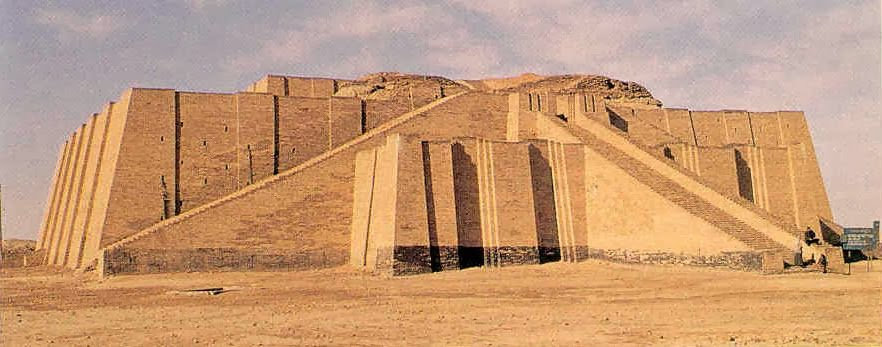
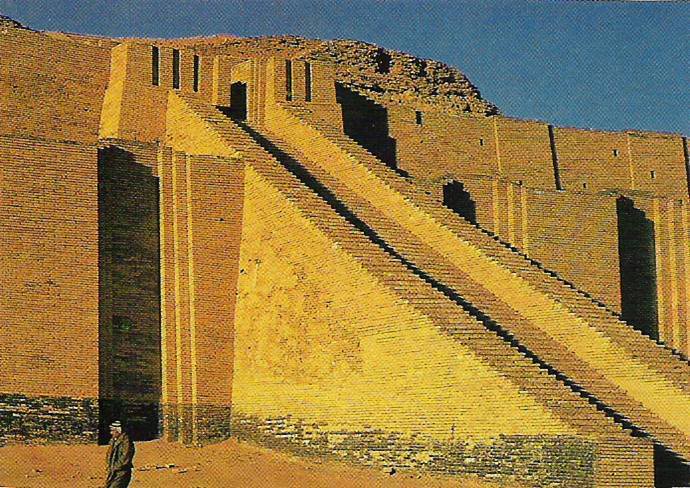
      The Ziggurat of Ur, which was built and dedicated to Sin, by the early Sumerians, was restored by King Nabonidus. The text of Nabonidus reads; “finding little left, but the first stage, and nothing to guide him, as to the monuments original appearance”. Nabonidus restored the Ziggurat to it’s early structure of 7 steps.

     The question still is who was Nabonidus and who was his father? Again similar to Sargon, Nabonidus was the son of a Great God, but unlike Sargon’s father Dagan, Nabonidus father was Sin. Nabonidus was probably the last great Nefilim, and Sin’s seed was in conflict with Dagan’s seed.

     The Sons of Annu used this same method to control the rule of Mankind over and over again. The use of the same M.O. same plot, same plan, and same outcome. Sargon, Moses and Nabonidus all have similar life stories. Simply put the seed of a Great God in a great position of power, and then rule mankind. Was this “Modus Operandi” used again to destroy the Jewish peoples, Dagan’s seed, in the Second World War?

For further reading; Blog: The Nephilim

     The next question and by far the most intriguing: Is Nabonidus still alive? We know that the Nefilim live a very long time, so is it possible that he still live? Would he be in a position of power and wealthy? Would he be a silent and unknown, almost arms length from the real seat of power? Hidden from the view of the public. So if he does exist then who would he be?

                                                              The Ankh

The Egyptian ankh was a symbol of life, or eternal life, and has recently become the national symbol of modern day Egypt in their efforts to expand their tourist trade. The Ankh is also said to mean the Key of life, or the Key of the Nile, as it is often depicted by Egyptians Kings as if they are holding the Ankh as a key. Note the illustration below.

        The origins of the Ankh go back to the very beginning of Egypt, and how the design is implicated into the meaning of life is unknown. The general feature of the symbol does seem to reflect the image of Isis as seen below. Isis means “throne” which is often depicted as part of her headdress. The King of Egypt was also often shown in a relief beside her as a small child. That would indicate that she was a protector of the King, and his power.

        The Coptic Christians soon took the Ankh to represent the Christian cross, but this wasn’t it’s original purpose.

       If you you observe the Ankh from another perspective, it looks very much like the ancient Shen, or the Omega symbols. They all have one underlying similarity. The representation of “Life”.

The Abzu

The Abzu of the Great Gods

The Abzu which is often spoken of in Sumerian text, and literally means “Distant water”; ab meaning water, and zu translates, far, distant or deep. Many experts have deciphered this, as place that originates ground water. Fresh water that maintains life, with the use of irrigation, but is this the true meaning of the Abzu?

In the Hymn to Elil, the text reads.. “the Abzu which no one can understand. It’s interior is a distant sea which Heaven Edge cannot comprehend”. In the curse of Agade, the text reads.. “Abzu… where the fates are determined”. In Sumerian text the Abzu is always preceded by the article “the”, which lends the belief that the abzu is a state of being or state of mind v.s. a specific location. As an example one might say they are going to New York, a specific location, or they may say they are planning to go to “the” city, which implies a state of being, as in shopping, nite life or dinning out.

In the Sumerian text relating Inana, (Enki’s daughter) and Enki; Inana speaks, “I shall direct my steps to Enki, to the abzu, to (Eridu), and I myself shall speak coaxingly to him, in the abzu, in (Eridu). Directed her steps all by herself towards Enki’s abzu  in (Eridu)…..Enki the King of the Abzu. …The lord (Enki) looked up at the abzu.”

It becomes apparent that the Abzu, is something that is a lot more than a simple source of underground water.  We know that from these texts that Enki is the source of the Abzu, and it is located in his city of Eridu. Enki is also recorded in the above text, to have to look up to the see the Abzu. To have to look up in a land that is extremely flat, must mean that Enki is looking up to the top of the highest building in Eridu, which would be the temple, Ziggurat. This is confirmed by a fragmented text, of the Heron and Turtle, which reads.. “Then on the Ziggurat…King Enki was on the Ziggurat, the great brickwork of the Ziggurat…the abzu, the brickwork of the abzu.”

In the middle figure (1) above an Anunnaki is climbing the Ziggurat at Eridu ,the 7 tiers of the structure are shown as coned levels, to speak to Enki, seated on his throne to the right, which is surrounded and encased by water.(Water is indicated by long wavy lines) Notice also that on the far left and far right are his attendants with their water poles. Could not this be the Abzu, that Inana speaks of when she wishes to speak to Enki? The second figure on the left is a Great God coming out of the Abzu atop the Ziggurat. The Abzu here seems lined with woven reeds, the same method used to build their boats and make their roofs water tight. The reeds are needed to keep the Abzu water tight to support a pool of water. Notice that the Ziggurat is always illustrated using the same markings in each illustration,as in many rounded conical triangles. This helps the viewer in understanding the depictions.

In the figure (2) below Enki is seen climbing to the top of the Ziggurat at Eridu, followed behind by his minister Isimud (to his right). At the top of the Ziggurat, an Anunnaki  is coming out of the Abzu, while water is being poured on top of him, as if exiting from a watery state. Notice again the Ziggurat illustration is always duplicated as stacked cones. Is this the location of the Abzu, that is a state of being, rather than a specific location, mentioned in Sumerian text?

If the Abzu represents a state of being, rather than a defined location atop the Ziggurat, then it must refer to a ceremony, a purification, or inauguration of some importance.

In the figure (3) above, we see Enki again, surrounded by a water enclosure, with his two attendants and poles, on either side of him. This depiction is seen as a top view, as if looking down from atop the Ziggurat, with Enki about to leave, his Abzu. In the curse of Agade, the text reads.. “King Enki, emerges from the Abzu.”

In the figure (4) above we see the Anunnaki, the same Anunnaki as in figure (2), exit the Abzu, atop the Ziggurat. This all raises the question. What exactly is this ceremonial practice, and what is it’s purpose? The Sumerians speak of a “washing of the hands” ceremony, which occurs at the site of the Abzu or in the Abzu. If the washing ceremony occurs in the Abzu, could it refer to a full emergence into water, or through water, as a number of the figures above seem to indicate. In the creation of man text, it speaks of Enki taking clay to form man at the Abzu. In the curse of Agade text, it reads, “May your clay be returned to it’s Abzu.” This seems to indicate that “life, creation of life , or the extension of life” would have a significance to understanding the Abzu and it’s ceremonies.

In figure (5) above we see an Anunnaki emerging from the Abzu atop the Ziggurat as depicted at the very bottom of the relief. Two upturned vases are pouring water into the vases at the bottom of the relief. The Anunnaki seems to have control over the water.  At the bottom of the figure are four wheels of 8 spokes. They represent the wheels at the four corners of the Chariot of the Gods, as does the other four wheels with 16 spokes. The wheel within the wheel. There is clearly a strong connection between the Chariot of the Gods, and the Abzu, which together enhances the abilities and life of the ancient Gods.

In the above figure (6), again the water is pouring from the top vases to the bottom vases as in the Abzu, while the occupant of the Abzu seems to be in a state of ecstasy and is some how connected to the Chariot of the Gods, similar to figure (5). This is very similar to the depictions of Enki and his ability to control water from his body. The Sumerians had the same word for water as for semen, which meant “the beginning of life or the renewal of life”, just as irrigated water brings life to a desert.The above figure also seems overjoyed if not in a state ecstacy while in the Abzu. The water is somehow transformed from the Chariot as it enters the Abzu. Both of the above figures are gaining a renewal of life as the water passes over them.

The real purpose of the ABZU? The Abzu is able to transform water to allow the Great Gods to extend their lives. Once in the Abzu they totally immerse themselves in it’s water. Without the Abzu the Great gods would simply have grown old like the rest of mankind and eventually died. They had to continually enter the Abzu and immerse themselves in it’s water in order to extend their lives. This is the state of being that is referred to as “entering the Abzu”. A state of rejuvenation. An exhilarating moment where water itself can be controlled and where one seems to levitate inside the Abzu.   This act of growing younger is seen in an ancient Assyrian scroll shown below. An old man becomes young again as they are about to drink water from the chariot..

It’s clear that the Abzu is controlled by Enki. This is shown (figure 7 below) by how Enki is depicted in ancient reliefs. Enki is seen having water or controlling water from his body, with the pole bearers on either side. Enki is seen to the right (figure 2 below) atop the Ziggurat, as shown by the figure on left, and at the centre of the Abzu, with water surrounding him.

(figures below)

The wavy lines represent water in Sumerian drawings, and it’s this water that has been transformed by the chariot of the Gods and is about to be extracted by the figure on the left..This is the water that these Great Gods immersed themselves in the Abzu and extend their lives…This is what is represented by the Tree of life in the middle of the figure..

The water after being transformed….and now gives life.

Ancient Annunaki Tree of Life - The Sumerian Gods the Anunna, Anunnaku, Ananaki

The great god shown above is not taking water to the tree of life as many have suggested but taking this transformed water away to be used to extend their lives. This is shown by the bucket in the figures hand.

            Enki’s position within the Anunnaki is greatly enhanced due to his control of the Abzu and his possession of the Tablets of Destiny. The combination of these two items which either enhance, empower or entitle each other, makes Enki a very important and powerful personage.

            In the Sumerian text of the curse of Agade, Ninurto takes from Agade all it’s wealth, just prior to it’s destruction, to Enki’s Abzu. The text also reads that the Abzu at Agade has it’s poles removed. Thus terminating the ability or power of the Akkadian Abzu. The text also refers to the wealth of Agade’s royal throne room. This wealth is stripped from Sargon’s royal family. Where does the wealth of Agade’s Treasury end?

            The text reads, “Ninurto brought the jewels of ruler ship, the royal crown, the emblem and the royal throne bestowed on Agade.” In Isaiah chapter 45, YHWH speaks of a dark and hidden place, that No man may know, where the treasures of the kingdoms of earth are hidden. After Enlil destroyed Yahweh’s political kingdom on earth, the Akkadians, and Enki took all their treasures prior  to the fall of their capital city Agade, was Yahweh retaliating in seizing many iconic earthly treasures of earthly kingdoms, just prior to their downfall? Did Yahweh seize Babylons earthly treasures just moments before she fell to Cyrus the Great?  Isaiah 45:3, reads as if speaking to Cyrus, “And I will give you the treasures of darkness, and the hidden riches of secret places,..” The word “darkness” would refer to a  fearful and forbidding place to man, while “hidden” and “secret” would refer to, No man being able to find these iconic treasures.

           Are these treasures stored in an ancient Abzu?

           To name a few treasures that no man has found, would be the ark of the covenant and the Cup of Semiramis, which weighed 15 talents of gold, or about 1500 lbs. This was essentially a very expensive punch bowl, for rather lavish parties. Golden icons were never melted down or destroyed in ancient times, but seen as war booty, to display over ones enemies. It wasn’t until the Greeks, that gold was a means to pay foreign trade accounts or used as a currency reserve. Prior to the Greeks, gold was basically bathroom fixtures for the ruling class. Would many of these iconic pieces, still be hidden from us?

The Anunnaki The Great Gods of the Sumerians

                                      The Anunnaki

The Sumerian text speak of their Great gods called the Anunnaki, which can have several meaning, but the Anu were the heavenly ones and Ki translates as earth, so the word Anunnaki could literally translate, “Those from heaven that were sent to earth”

    Compared to the Sumerians the Anunnaki were very well dressed and groomed. Their breads were long and braided and their dress was formal and heavily embroidered.

Anunnaki Watch Water Offering Water Sumerian Gods

     In the image above an Anunnaki is seen wearing  his formal dress and having well groomed long hair and a braided beard. This was not only how they dressed, but it was signifying their position and who they were.

The early Kings of Mankind’s history copied this dress, and braided beards, to indicate their status as royal. The female Pharaoh’s of Egypt would even wore false braided beards to indicate kingship.

     The image above is the King of Assyria and the King of Babylon seen while they are shaking hands.What is of note is their dress and braided breads. Their attire is solely for their royal status, copied from the Anunnaki whom they saw as the pinnacles of status.

     The Sumerian text records the Anunnaki as coming from heaven to Earth, but they were definitely human. They were not spirit forms. They had the ability of long everlasting life, but they were not immortal and could die, either by accident or by combat. They seemed to enjoy the contact with mankind and enjoyed the pleasures of the women of Sumeria.

     The relationship with the Sumerians took a symbiotic relationship, with the Sumerians acquiring scientific, agriculture, husbandry and mathematical  knowledge from the Anummaki, while the Anunnaki received labour to irrigate and grow crops, produce beer and most importantly mine significant amounts of ore.

     The Anunnaki were administrated by a council, and the council had leaders. Enki was one such great leader and his name means, En translates as lord and Ki translates as Earth. so therefore Enki was the “Lord of the Earth”. All important issues were discussed at these council meetings and agreed upon. Any criminal or civil action could also fall under the authority of the council. As a case in point of a rape charge against a high ranking Anunnaki. The girl was brought before the council and questioned, then cross examined. Similar to a modern court drama. The result was the Plaintiff was found guilty.

     The first thing the Anunnaki did upon arriving on Earth was to construct a city. Enki builds what is considered the first city built on Earth named Eridu, at the southern end of the Mesopotamia valley, and in this city a temple is built. The text reads;

“Next to Anu he seated EnlilNintu he seated at the big side, The Anunnaki seated themselves one after the other. Enlil says to the Anunnaki: ” Ye great gods who are standing about, My brother has built a house, the king Enki; Eridu, like a mountain, he has raised up from the earth, In a good place he has built it. Eridu, the clean place, where none may enter, The house built of silver, adorned with lapis laz uli,”

The mound of the ancient city of Eridu, located in southern Iraq. There is also topographical evidence that the city once had lakes surrounding it.

One of the pleasures Enki has while living in his city, was to go for a boat ride on the lakes near Eridu,, really not much different than people today enjoying the water. Below is an ancient illustration of Enki in his boat;

      Next was the construction of the temple, which was elaborate and extensive. The question is; what was it’s purpose?Modern archaeologists believe that being a temple, they must have served as a religious importance, but is this true? Others suggest ancient temples were aligned with the stars or constellations. And still others believe that they were aligned with the spring equinox or the summer solstice.

What was special about these temples that were constructed in ancient Sumerian cities, was they were not constructed for the Sumerians. Either for their use as in worship or as a centre for their culture. The temples were built for the absolute sole use of the Anunnaki. This point is very clear.

The temples were called Ziggurats, The Ziggurats were constructed of 7 levels rising above the city with their corners, not their sides pointing to the four compass direction points. There was no astrological connection to their positioning, or an alignment to the spring equinox or summer solstice. The Anunnaki were highly intelligent and didn’t require a building site to determine the approaching of spring or when summer was near. So the question still remains what were these temples built for? Below the Ziggurat at the ancient site of Ur, which had been rebuilt many times over the Centuries.

Just as Ancient Mankind copied the dress and appearance of the Anunnaki they also copied their temples. The Egyptians long before they built pyramids they built exact replicas of Sumerian Ziggurats. They were called Mastabas and like the Ziggurats they were built from clay bricks.

     The Mastabas (above) had the same tier leveling architecture, in following with the Ziggurats of Mesopotamia. The Egyptians understood the style of construction but as with the Sumerians they never understood their purpose.The Egyptians determined them to be burial sites for their Kings. The Anunnaki though had no concern for a burial site since they had the opportunity for everlasting life.The ancient cuneiform text reads;

            What you seek you shall never find.

          For when the Gods made man

          they kept immortality for themselves.

     The unified ruler of ancient Egyptian under King Djoser in the aerial photo above, shows his pyramid with it’s 7 steps at Saqqara. Pyramid temples were built near the centre of a complex indicating their importance.

     These temples were extremely important to the Anunnaki as many of their reliefs show them atop their Ziggurats. At the top to the Ziggurats was the temple centre piece, and this substantiated the existence of the Temple itself. This singular important location was what the Anunnaki called the ABZU. The meaning of Abzu is distant or deep water. Ab translates as water and Zu as distant/ deep.


      The Abzu is something more than just distant water, as this text suggest; “Abzu the pure place where the fates are determined”.

      The Abzu was central to their very lives for without it, the Anunnaki would loose their longevity to their exsistence.

                                              {The Sumerian Abzu Blog}


     In the Sumerian tale of the Turtle and Ninurta, Enki sets an ambush at the gate of the Abzu, and traps Ninurta.

Against Ninurta, Enki fashioned a turtle from the clay of the abzu. Against him he stationed the turtle at an opening, at the gate of the abzu.

This gate is at the top of the temple Ziggurat.


     The above image shows an Anunnaki that has climbed atop the Ziggurat, (illustrated by the cone shaped objects, as if indicating the 7 tiers of the Ziggurat itself), and making entreaty to Enki seen siting at the gate of the Abzu, surrounded by water. (also illustrated as the door atop the coned Ziggurat just above the Anunnaki)

      These pyramid shaped temples were built wherever the Anunnaki resided on earth. In Egypt and in South and Central America some these magnificent structures still remain. Centuries later long after the disappearance of the Anunnaki, mankind chose to use them for their own purposes. These temples then became central to the religious beliefs of man. These temples then changed from their original purpose to become part of an after life and a venerated burial site for mankind.  To this day archaeologists believe that the Great Pyramid was built by the Old Kingdom of Egypt. A civilization that up to that point in history showed little ability to build such an empowering structure.

    In 1822, the Italian Egyptologist Bernardino Drovetti discovered a mysterious papyrus document near the Thebe’s necropolis. It dates back to the Dynasty, during Ramesses II reign.

This document was called the Turin Royal Canon  and speaks about  Zep tepi or the First time of Osiris.

The main characteristic of this document is a long list of Kings of Egypt that ruled Egypt pre diluvian, before the thirty dynasties that scholars today officially approve. This gives rise to a much longer period of a sophisticated society living in Egypt, when the Great Pyramid was originally built. The sequence of the King’s listed, originated some 33,000 years before the dynasty age.

What gives credence to this document is that the Sumerian King List also lists ruling Kings in the Valley of Sumer, that ruled in this pre flood era. Two unrelated documents  that both record the same history, make the history authentic. Scholars still do not accept this as history, but see this period as simple myths.

John Anthony West proposed his reasoning, absolutely worthy, when he wrote:

As if today’s Egyptologists know more about ancient Egyptian history than the ancient Egyptians themselves. That is the standard height of academic arrogance

(West’s research was dating the Sphinx extensive water erosion that can be seen from atop the Sphinx)

Who did build the Great pyramid? Most scholars believe that Khufu was responsible for the earth’s greatest construction feat, pointing to his cartouche in the Campbell’s chamber as giving evidence.

Fig. 1 above is the existing cartouche in the Great Pyramid

Fig. 2. Above is the cartouche recorded in Vyse’s journal.

In May 27th 1837 Col. Vyse recorded in his  journal a cartouche he discovered  in the Great Pyramid. What is bizarre about his cartouche is that it does not spell Khufu’s name correctly, Vyse’s cartouche has since been modified in a restoration to correctly spell Khufu’s name as indicated in Fig. 1 to support the belief of the builder of the Great Pyramid. This oddity is not the most unusual detail about a King recording his name on such a  magnificent structure.

The Great Pyramid has no painting, no art work, no painted drawings, no inscribed depictions and no stone cutting depicting a language or figure.

If you were a great King of Egypt; would you send someone to misspell your name in paint which fades through time, in one of the most difficult and obscure locations in the pyramid, when the whole of the pyramid is entirely bare?

Who painted this mispelled  cartouche?  None other than Vyse himself. He painted the cartouche of Khufu to gain for himself fame,fortune and note aridity, thus being the first to identify the builder of the Great Pyramid. If he drew the cartouche in a well known visible location in the pyramid it would have been quickly seen as a fake, but hiding the cartouche in a very difficult location would allow his fiendish plan to be accepted.

Since then, scholars have been misled to believe that Khufu was the builder of one of the seven wonders of the world.  The normal evidence of the steps required to achieve such an imaginative process are lacking, and neither the physical construction nor the social philosophy behind it have no historical precedent in Egypt.

Mankind may have started over several times throughout the millenniums of time that man has existed on earth. The great period of time before the diluvian epoch, gave rise to some advanced learning, which enabled the Egyptians to build great structures.The Great Pyramid and the Sphinx were both built during this time when the Gods ruled Egypt and walked among mankind.

       Many of the reliefs of the Great Gods show them having a 1/2 man half fish like appearance. In the relief below is a very common depictions showing the Anunnaki on either side of the tree of life and looking up and pointing to a chariot of the Gods. Their appearance is fish like.

      In one of the earliest known artifacts of a sculptured Anunnaki, dating around 5000 BC , the Anunnaki is wearing the horned headdress and long bread, indicating his status, but also what appears is that his skin, has a fish scale like appearance.

      Were the Anunnaki able to extend their lives as the relief seems to indicate with the help of their chariot of the Gods?

             {The Babylonian History of Mankind Included a Great Creature Named Oannes  blog}


Not just extend their lives, but change their form.

      By about 2000 BC the Anunnaki start to disappear throughout the earth. For what reason no one is sure. One suggestion is that they are losing their influence and power over mankind as man’s earthly knowledge was superseding their need for the Anunnaki. They were no longer seen as Great Gods. One thing is sure is that one Anunnaki stayed on earth to influence man. That God was Dagan, the God of the Semitic people.

                                  { Dagan the First God of the Semitic People blog}


      Dagan was marooned on the earth, by Enki’s  order. After the destruction of the Akkadian nation and it’s great city Agade and just prior to the fall of Agade it’s capital,  Enki orders all of it’s treasury, of this great city, to be brought to his Abzu. Enki doesn’t stop there but atop the Ziggurat at Agade the poles of the Abzu are to removed by his order, indicating that the function of the Abzu for Dagan is finished.

The text reads; “Ninurto brought the jewels of ruler ship, the royal crown, the emblem and the royal throne bestowed on Agade.”

                         “Enki tore out its well-anchored holy mooring pole from the abzu. Inana took away its weapons.”

       Dagan at this point is alone, and without connection to the Abzu controlled by Enki, he is now isolated and marooned on earth. The text indicates that all the Anunnaki had turned against Dagan to destroy his Semitic seed, the Akkadians.

       Dagan then becomes the driven god of the Semitic people. To make them rulers of the Earth. His ego and lust for power seeks no end.

      The  Bible texts indicate what he has become; The God of the Semitic Akkadians had become a God of never ending “bragging”.  Isaiah 45; versus 11-21 is just one of the many examples, Job chapter 38 another. “I made the earth and I created man- I created the heavens”. There is pages upon pages of this never ending self posturing, incessant bragging. My point from all of this is; if there is a ‘One God the creator”, that sees fit to come down from his heavenly place, and speak to a lowly human on earth, which can be no more than a fly speck in relation to the Universe, then why does he have to spend an inordinate amount of time bragging to this fly speck? Does he have some personal insecurity issues, or is this an attempt by Dagan/ Yehwah to support his need and human reliance and therefore vindicate his own agenda. I just cannot imagine an omnipotent God the Creator, to feel the satisfaction of man’s approval, and the need to be worshiped. It sounds preposterous.

      Is there some indication that Dagan is still alive, influencing the world, or without the Abzu has he died as with all mankind?

The Sumerians

                                        The Sumerians 

Human history  from a recorded historical view begins in the lower Mesopotamia, which means between the rivers. These two rivers are the Tigris in the north and the Euphrates in the south, which both drain into the Persian gulf. All of the major cities in ancient times with one exception, were built on the Euphrates, and none on the Tigris and for several good reasons.

The map of the Euphrates shows the ancient cities, that are no longer on the river, as the river has changed its course over time.

The most important fact was that the Euphrates river facilitated itself to irrigation more so than the Tigris. The banks on the Euphrates are low and flat, while the banks of the Tigris are high, and more rugged, which would’ve meant the water from the Tigris, would have to be lifted, in order to irrigate. This also meant that the Tigris river banks were stronger not allowing the river to shift it’s course through time. This was the exact opposite to the Euphrates, which through time has seen many major changes in it’s course flowing south.  Many burial mounds of cities that existed in ancient times on the Euphrates are now miles east or west of the current Euphrates. These include the cities, Babylon, Kish, Nippur, Uruk,  which all at one time in their early existence,were situated on the Euphrates. Through diggings and the findings of ancient texts, it can now be determined without question, that these cities were all built on the Euphrates. This can be proved by one of Hammurabi’s texts, that describes an order to dredge the Euphrates from Larsa to Ur, “clean out the stream of the Euphrates”. Both of these cities today, do not exist on the southern Euphrates.

In comparing the ancient course of the Euphrates to the one that exists today, two very noticeable differences can be made. The middle course of the Euphrates has shifted dramatically west, while the very southerly section has shifted to the east.

The most notable geographical feature relating to the Mesopotamian valley is the flatness of the land, particularly near the Euphrates. This lends itself to intensive farming. The flatness of the valley has one very notable downside in ancient times. This was the fact that it’s large and powerful cities, were difficult to defend. There was no natural defencive obstacles that would hinder the movement of invading armies. Wars and their subsequent armies were a very common occurrence in ancient times, and they all passed through the Mesopotamian valley. The other common feature that exists throughout this valley delta, is the lack of building material. With the exception of clay to build bricks, there is no stone, so the mighty cities along the Euphrates were all built of clay bricks, which over time, turns to mounds of dirt. There is one exception and that is the city of Eridu,( considered man’s first city), which had some stone in it’s construction.

The ancient city of Eridu, one of the five preflood cities, exists today as a mere dirt mound in modern southern Iraq. Clay bricks eventually turn to dirt, and without water for irrigation, the cities were eventually abandoned.

These mighty cities of the Euphrates were in sharp contrast to the stone monuments erected by the Egyptians, which still stand today. The other downside to clay being the only building material, is that clay is the only material to write on. Hence clay tablets are all that exists today from this period, to study and learn from their culture. Though many have survived, clay tablets as a writing surface are not the most enduring. This again can be in contrast to the Egyptians who painted or carved their language onto stone. The Egyptian also wrote on papyrus, but many only exist in fragmented form today.

The first people to live in this valley were the Sumerians. They lived in the very southernmost region, bordering the Persian gulf and they called their valley, Sumer.  The Sumerians were the first in human history to have a written language. Symbols or letters that represent a phonic sound is what defines a written language, which is quite different than a series of pictures to represent an event or action. They wrote their language on a wet clay,often using a stylus. This form of writing came to be called cuneiform writing. They also developed a basic law code, and a legal system using cuneiform to keep legal records.


The Sumerians had Gods. The  highest of these Gods was Anu, meaning heavenly one, or God of Heaven. The Princely offspring of Anu, were called the Anunnaki, meaning born of royal blood, and these lived amongst the Sumerians in a very symbiotic relationship.  Within the Anunnaki there was a counsel of leaders that directed and led the Anunnaki.  These Gods had no spirit form, as the God of the Bible. They were not perfect, all knowing or omnipotent. They were of human form, had human interest, as in they liked to drink beer, and have prolific sex with the beautiful women of Sumeria. The reason they were seen as Gods to the Sumerians is that they possessed technologies, unknown to the Sumerians. These technologies and sciences were taught to the Sumerians to improve their methods of intensive farming. Simple math, and building techniques were also taught. Therefore the Sumerians called them Great Gods. In essence the Anunnaki provided the technologies and the Sumerians did the work.

The Sumerians were modest and humble which is reflected in their dress, consisting mainly of a simple tunic. They were clean shaven, and also were thought to shave their heads bare. In a more formal setting, the Sumerians would wear wigs. This form of modest dress was possibly in showing respect, as in having a humble attitude towards their Great Gods, whose dress was in sharp contrast to the Sumerians. These Anunnaki  wore heavily embroidered garments similar to Roman togas, with end of the material flung over one shoulder.  Their beards were long and braided, and their heads were full of wavy hair. The Annuna also wore a headdress which was the inverted horns(horn tips pointed inward)of a bull. This was evidently signalling their higher position in their order. The Sumerian men below show their simple dress appearance.

Fig. 1

The Sumerians were soon to have neighbours to the north of their valley. They were to be called Akkadians, named after their capital Akkad or Agade meaning born of Akkad. In Genesis 10:10 it mentions Akkad, pronouncing it Accad or in Greek Archad. The Akkadians were thought to have come from the south, led by their Anunnaki God, Dagan.

These Akkadians were the first Semites on earth, and not of the same race as the Sumerians. The roots of the word Semite, is semen, and seed, these people being the seed of Dagan, their God. Their language was distinctly different than the Sumerians. The Sumerian language was built, by starting with a word and building more words around that single word to develop more complex thoughts and phrases, while the Akkadian language used roots, which may or may not have any meaning, then by changing letters with the root, different meaning are derived. The Akkadian language can be likened to an early version of Hebrew and as in our English language used roots, while the Sumerian language had no language that would, living or dead, be considered close to their ancient spoken or written language. The Akkadians did not have a written language so they borrowed the cuneiform style of writing from the Sumerians.

       Both Akkadians and Sumerians were competing for the same resources, food and land, on a very limited valley, which would have brought them into conflict. This conflict met its zenith, and turning point with the birth of  an Akkadian King, named Sargon. Dagan as all Anunnaki (Great Gods), had courtships and sex with numerous desirable and beautiful females within the region, and once Dagan saw a Priestess of Kish, that was especially beautiful, he sought her, and from this relations she gave birth to an illegitimate child, who came to be called Sargon. Through a series of events her son, Sargon becomes king, and immediately, sets out to conquer the entire southern Mesopotamia , including the Sumerians. With the help of Dagan, Sargon butchers and annihilates all the neighboring territories and city states. Before long Sargon has the great southern Sumerian city of Ur in a long protracted siege.  After it’s fall and with the Sumerian victory complete, he washes his hands and sword in the Persian gulf, as if saying he’s “finished with it”, similar to Pontius Pilate washing his hands, centuries later. This then establishes the Semite kingdom as a leading power on earth, and abruptly ends the people of Sumer. Sargon’s military victories enables Dagan’s Semitic Kingdom to become the first, dominant power in earth’s history.

       Early Sumerians all had one thing in common through out their many reliefs that illustrated them as a people. They were illustrated most often as naked. These illustrations depicted the early Sumerians as totally naked as they went about their daily chores. Totally without shame, similar to the Bible’s story of Adam and Eve. They appeared on these reliefs also without any facial or body hair. Even their heads were hairless.

The Sumerians above are at work serving drink and food totally naked and hairless. These early Sumerians were called, “the black headed people”, which seems to indicate, by the phrase “black headed” that they had no hair on their heads, or exactly as they were illustrated in their reliefs.

       The Sumerians were in direct contrast to their Great Gods. These Gods, seen in the figure below, had enormous amounts of body and facial hair. If you look closely to their facial features, in the relief below, you’ll notice large over sized eyes, large drooping noses, and over sized ears. These features are often seen amongst the people of India and the Indus Valley. Did these Gods and their prolific sexual encounters with the women of the valleys of Indus and Sumer transfer their genes to man, that produced body hair and distinct facial features?

       Native peoples today, throughout the world, are basically without body and facial hair. Native people of North and South America, along with native peoples in the Pacific Islands, do not have facial beards. The reason for this, would be that they had no direct contact with these ancient gods. Peoples that have facial hair today are from the Middle East and the India. As civilizations moved North and West, these genes came with them. Central and Western Europeans also have this gene for facial hair. Still man’s early gene that produced no head of hair, often appears as baldness, as seen in many Western European peoples.

      This seems to confirm that mankind today, is a hybrid of early man and their gods. The genes of both are apart of modern mankind.

       The Sumerians also had their Hero’s. Gilgamesh was the greatest. He reigned as the King of Uruk, so he was both a mythological figure and a real figure. The acts he performed distinguished his bravery, which resulted in these stories gaining mythical proportions. These elevated tales of Gilgamesh were discovered in the British Museum in 1872, by George Smith. These tablets were earlier brought to England from their discovery in the great Library of Nineveh.

Shown above is a relief of Gilgamesh, with his full facial beard, which he would have inherited from his mother a goddess. He therefore was what the Greeks referred to as a demi god, because he was half god. The genes of his mother were now part of his DNA.

       The tales of Gilgamesh and his heroic adventures, can be likened to a Greek Heroes. The Greek tale of Jason and the Argonauts describes his adventure into the Black Sea in search of the golden fleece. The account is so well described that it allows modern readers of the tale to follow his exact travels. This is similar to the tale of Gilgamesh. His great adventure likewise can be followed, as if on a tourist map, as he slays evil and monsters alike.

       The Tale of Gilgamesh also has an entirely different twist. In the Book of Enoch; which has several books including The Book of the Giants, Gilgamesh is mentioned twice. The only time his name is mentioned outside of cuneiform text. His name mentioned twice from two completely unrelated sources points to him being an actual personage. The text from the Book of Giants; the giants are discussing a dream;

1 concerns the death of our souls [ . . . ] and all his comrades, [and Oh]ya told them what Gilgamesh said to him 2[ . . . ] and it was said [ . . . ] “concerning [ . . . ] the leader has cursed the potentates” 3 and the giants were glad at his words. Then he turned and left [ . . . ]

        Gilgamesh is not a hero figure, as in Sumeria, but in the Book of Giants, the opposite is true. He is part of the Nefilim (giants) and monsters, that inhabit the earth and bring ruin and evil upon it’s people. Quite a shocking difference. In the Book of Giants it states that 200 Gods (watchers) came down to earth and had relations with earthly women and animals that produced offspring, that were called giants and  monsters. Book of Giants reads;

 they defiled [ . . . ] 2[ . . . they begot] giants and monsters [ . . . ] 3[ . . . ] they begot, and, behold, all [the earth was corrupted . . . ] 4[ . . . ] with its blood and by the hand of [ . . . ] 5[giant’s] which did not suffice for them and [ . . . ] 6[ . . . ] and they were seeking to devour many [ . . . ] 7[ . . . ] 8[ . . . ] the monsters attacked it.

       In the Sumerian account it speaks of 300 gods, (annunaki) that come down to earth, and administer the fate of man. A certain Sumerian does run with wild animals and has sexual relations with them, but this is frowned upon by Gilgamesh and the other Sumerians. Gilgamesh then takes necessary steps to stop these illicit acts. At no time is there ever any offspring from these relationships.  This is one of the discerning turning points between the Enoch’s account and the Sumerian account, the resulting offspring between man and gods.

      Gilgamesh, though seen as a Sumerian hero, but still is definitely a Nefilim, controlling the fate of man, taking what he wants, including wives for himself. Sumerian test reads;

“Gilgamesh did not allow any virgin to be together with the one she loved,”

       In the Bibles account this offspring, between man and gods, is sinful, and leads to ruin, that must be destroyed and removed from the surface of the earth. In the Sumerian account the Nefilim were to lead to man’s genetic improvement, and ultimately improving his physical statute and mental abilities. The question that the Book of Enoch raises is would this level of mankind cooperating with the Nefilim continue forever? As the Book of Enoch suggests there is eventual conflict, between man and the Nefilim.

       In the dreams that the giants are having, it would point to their destruction. They become frightened and ask Enoch to interpret their dreams. Enoch tells of their fate, which is the result of the ruin that they have brought upon the earth.

       These two varied accounts really illustrate the Bible’s religious view of good v.s. bad, sex and it leads to sin theory,which is in direct contrast to the Sumerian account which would embrace the idea of miscegenation for enhancing mankind. Conflict though, would soon arise.

      The Sumerians had a counting system based on 60, (10 and 6).  This seems rather difficult in calculations, but this system, has its merits, as 60 has many divisors, and has given us the 60, as in seconds in a minute,and 60 minutes in an hour. The Sumerians also had a rather developed legal system, and the one significant thing we still use from them today is the seal. Any legal document had to have seal before it was considered legal. This carried on down through Roman times and even today. That little red dot beside your signature on a legal document, is from the Sumerian seal.

       The Sumerians left us with our first written language, our first legal code, and an insight into mankind’s earliest developments of civilization.